
Medical Device Injection Molding: Tools That Pass Audit
Medical device injection molding is ordinary injection molding wrapped in a documentation system. The physics are identical: polymer is melted, injected into a steel cavity, cooled and ejected. What is different is that every decision in the process leaves a trace somewhere in the customer’s regulatory file, and a supplier who cannot produce those traces is not able to support the product no matter how good the tool is. That shifts the real question in a medical tooling project. It is not “can you mould this part”, which almost any qualified shop can answer. It is “can you show me, in writing, what you did, what you measured, and what you checked – and can I audit it”. Buyers who treat medical tooling as a higher-spec version of commercial tooling usually find that the specification is the easy part, and that the hard part is the evidence chain around it.
Why the evidence chain matters more than the equipment
Medical device injection molding produces parts to the same physical process as any other injection molding, under three additional constraints. The material must have an established biocompatibility position for the intended body contact and duration, and must survive the chosen sterilisation route. The tool must be designed so that its features and its maintenance regime address named risks in the customer’s risk management file, rather than simply being a good tool. And the process must be qualified across a defined window, with records that demonstrate consistency rather than a single successful trial.
None of those three is technically hard in isolation. All three become hard in combination, because each one constrains the others. A resin with excellent biocompatibility history may not tolerate the sterilisation method the product requires. A tool designed to eliminate flash may need a parting line configuration that the risk file has to describe. And a process qualified for one cavity count may not hold across the tool that actually gets built. The suppliers who do this work well are not the ones with the most machines; they are the ones whose process produces a coherent record.
The practical consequence for a buyer is that the evidence chain matters more than the equipment. A shop with a 500-ton machine and no traceability loses to a shop with a 200-ton machine and a lot-traceable process, because the second one can support the product and the first one cannot. If you are comparing quotes, ask to see a trial report and a preventive maintenance schedule from each. The price gap between the two is usually smaller than the gap between their documentation.
Three gates a medical tool has to pass
It is useful to think of medical tooling as three sequential gates, because each one has a different failure mode and a different point in the project timeline where it can be caught cheaply.
Gate one: the design input. Before a line of steel is cut, the customer must have established what the part contacts, for how long, how it will be sterilised, and what risks it carries. A supplier who does not ask for this at quotation stage is signalling that they do not work to that standard. The practical test is simple: describe your product’s contact category and sterilisation method in the request for quotation, and see whether the reply asks a follow-up question. A reply that only confirms capacity and price means you are talking to a general moulder.
Gate two: the tool design review. This is where the risk management file meets the mould. Features that could produce a defect under wear or improper maintenance – flash-prone parting lines, thin webs that could ” break and leave a fragment, wear surfaces whose degradation has a defined consequence – are named in the risk analysis, and the tool design has to address them. The review is also where the cleanability constraints get applied: geometry that cannot be cleaned is a liability in a medical application, and it is far cheaper to change a drawing than a cavity.
Gate three: the qualified process. The tool is built, tested, and demonstrated to produce conforming parts consistently across a defined process window rather than at a single set of parameters. This is the gate most often under-specified commercially, because a buyer who is not familiar with validation reads “trial passed” as sufficient. It is not. A trial at one set of parameters proves the tool works. A qualification run across the window proves the process is in control, and only the second one supports a release.
Two commercial notes on these gates. First, the first one can be closed during the quotation phase at effectively no cost, and every week it stays open is a week of schedule at risk. Second, the third one costs real money, because qualification runs take machine time and produce parts that have to be disposed of. That cost belongs in the quotation explicitly, and a supplier who does not mention it is either unaware of it or is going to charge for it later.
Medical plastics: what has to be true before you mould it
Material selection in medical molding is constrained from three directions at once, and a resin that satisfies one direction can fail another. The chemical direction is biocompatibility. The process direction is sterilisation tolerance. The engineering direction is whether the part can actually be moulded to the geometry in the drawing at a production rate.
The most common sourcing error is specifying by polymer family alone. A request for “medical grade polycarbonate” is not yet a specification, because medical grades of the same polymer differ in additive packages, in available certification and in what has been characterised for which contact category. The specification that resolves this is a triple: the body contact category, the contact duration, and the sterilisation method. Give a supplier all three and you will get a resin with a documented position for your use. Give them one and you will get a question, and that question is a good sign about how they work.
| Material family | Typical medical use | Biocompatibility route | Sterilisation tolerance |
|---|---|---|---|
| Medical grade polycarbonate | Fluid connectors, housings, transparent shields | ISO 10993 series evaluation for the intended contact category | Autoclave, gamma and EtO generally tolerated; verify per grade |
| ABS (medical grade) | Diagnostic device housings, equipment covers | Chemical characterisation plus contact testing where skin contact applies | EtO and gamma common; autoclave only for specific grades |
| Polypropylene | Syringe bodies, bottle components, consumables | Well-established position for short-duration indirect contact | Autoclave tolerant; good candidate for radiation too |
| Polyethylene (PE) | Fluid paths, plungers, seals, bottles | Extensively characterised for contact applications | Autoclave and radiation generally tolerated |
| Polycarbonate-sulphone / PSU | High-temp fluid handling, surgical device parts | Characterisation and chemical contact testing per intended use | Autoclave tolerant in many grades; confirm before specifying |
| Polyamides (PA) | Connector bodies, high-strength mechanical parts | Contact testing required; amine content matters for some routes | EtO and gamma common; autoclave limits for some grades |
| Thermoplastic elastomer (TPE) | Soft-touch grips, seals, valve parts | Requires case-by-case evaluation; additives drive the outcome | Depends heavily on the specific formulation |
| PVC (medical grade) | Tubing, fluid lines, containers | Well characterised; plasticiser content is the key variable | EtO common; radiation can discolour and degrade |
Two practical points that are worth raising at design review rather than after the first trial. Additives matter as much as the base polymer, and a grade change or a supplier change for the same resin family is a change that has to be assessed rather than assumed equivalent. Trade sterilisation routes against the resin before the tool is designed, because switching routes later can force a resin change, which can force a tool change, because the geometry tolerance achievable in one resin is not always achievable in another.
Sterilisation method vs material
Sterilisation is where the material decision gets made for you, and it is therefore the decision to sequence earliest. A resin has to tolerate the method repeatedly, at the dose or temperature the method implies, and for the shelf life the product claims.
The table below is not a compatibility list. It is a map of where the mismatches happen, because the mismatches are what cause the recall and the re-tool.
| Method | Mechanism | Material risk | Design response |
|---|---|---|---|
| Autoclave (steam) | Moist heat under pressure | Hydrolysis and loss of properties in condensation-sensitive polymers | Verify grade approval; check for hygroscopic loss of dimensional accuracy |
| Gamma irradiation | High-energy radiation | Chain scission; embrittlement over dose; colour shift | Confirm cumulative dose limit for the resin; dose accumulation across lines matters |
| EtO (ethylene oxide) | Chemical alkylation | Residual EtO limits; some polymers embrittle | Confirm residuals and aeration cycle; material selection is critical |
| Dry heat | Hot air at elevated temperature | Oxidation and dimensional change in some grades | Temperature ceiling must sit below the resin’s distortion temperature |
| Vapour hydrogen peroxide | Oxidising vapour | Surface degradation of some polyolefins | Confirm compatibility; often used for polymers that resist EtO |
| Sterile barrier packaging | Not a sterilisation method | The failure point in most real recalls | Validate seal integrity and packaging process separately from the part |
Two things in that table are routinely missed. First, gamma irradiation has a cumulative dose limit: a part sterilised at the supplier and then irradiated again at a hospital or a contract steriliser exceeds the resin’s dose tolerance in a way that no single facility can see. Second, sterile barrier packaging is not a sterilisation method, and it is where most real-world sterile product failures originate. The part can be perfect and the seal can still fail, and the validation of the packaging process is a separate exercise from the validation of the moulding process.
Our injection molding materials reference covers the engineering side of resin selection – shrinkage, flow, cooling and warpage behaviour – which is what determines whether the part can be moulded to the tolerance the drawing calls for. The medical question sits on top of that: once the engineering choice is made, the biocompatibility and sterilisation position has to be established for that specific grade.
Which standard governs which part of the work
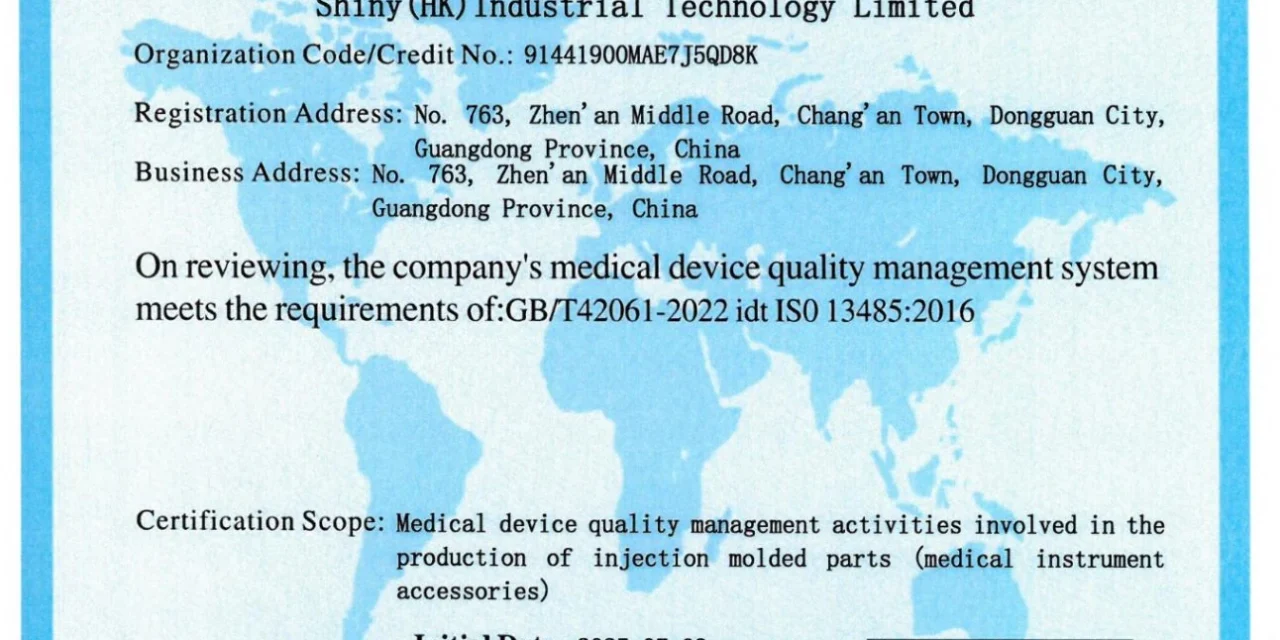
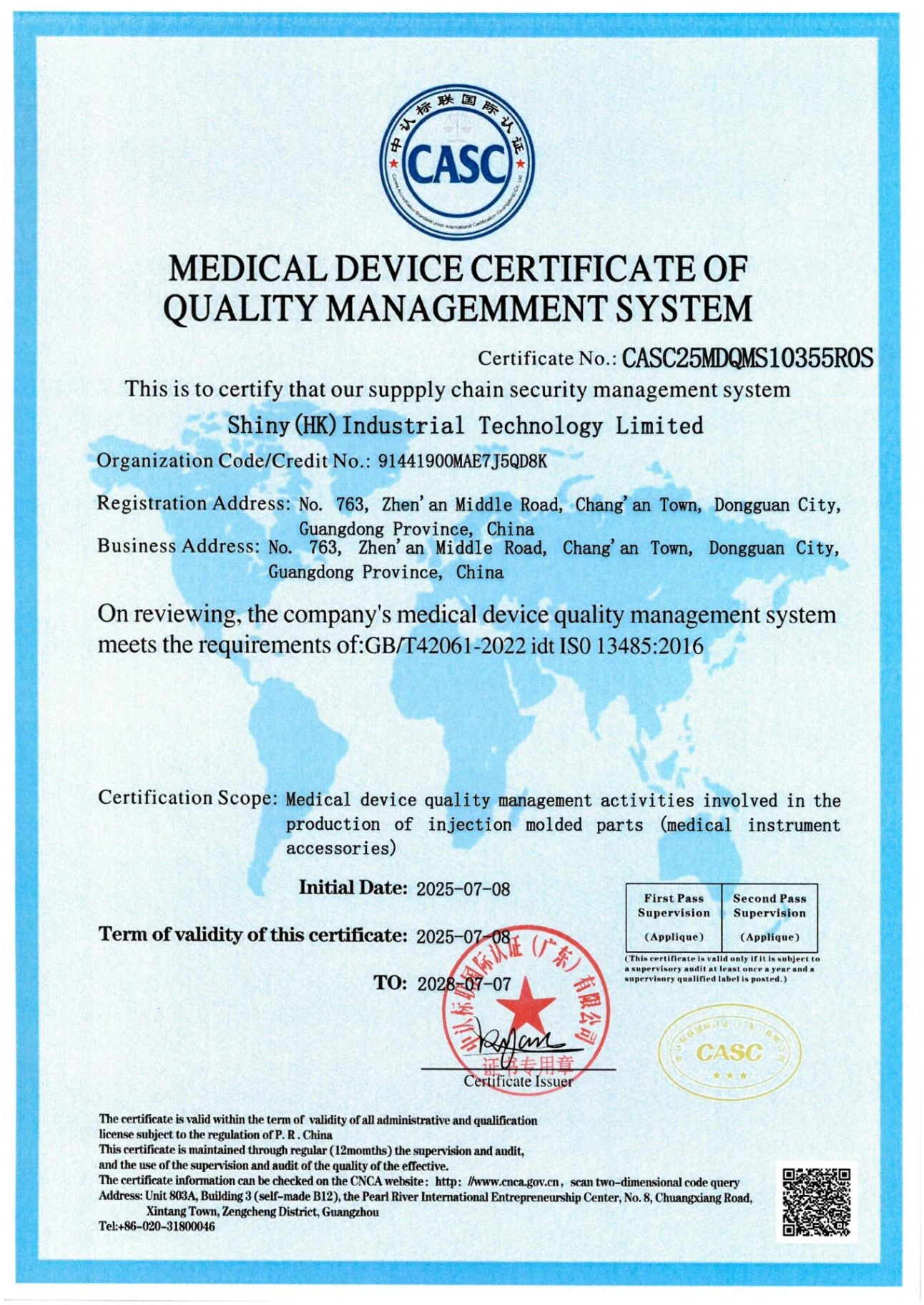
The standards picture is where most confusion happens, because buyers and suppliers use the same words to mean different things. The most common misunderstanding is that ISO 13485 is a certification the mould maker holds for the customer’s benefit. It is not. It is a quality management system standard for the organisation that makes or supplies the device, and the mould maker sits inside that system as a supplier of a process.
What that means in practice for a tooling project is worth spelling out. If the customer is a medical device manufacturer, their certificate governs the product. The mould maker’s contribution is a set of controls and records that the customer’s own quality system can rely on as evidence, and that the customer’s auditor is entitled to inspect. That is a different conversation from “are you ISO 13485 certified”, and it is the one that actually determines whether an audit will pass.
| Standard | What it governs | Where it touches the mould | Who usually owns it |
|---|---|---|---|
| ISO 13485 | Quality management system for medical device organisations | Supplier controls, records, corrective action, change control | Customer’s organisation; audited at the supplier |
| ISO 14971 | Risk management for medical devices | Tool design features and maintenance that are named risk controls | Customer’s risk management team |
| ISO 10993 series | Biological evaluation of medical device materials | Resin grade choice and whether the part contacts the patient | Customer, supported by material data |
| ISO 20417 / 15223-1 | Information supplied by the manufacturer | Indirectly: label, instructions and markings are often moulded or laser-marked | Customer |
| ISO 11607 | Sterile barrier packaging | Packaging tooling and the cleanliness of the presentation | Customer, with packaging suppliers |
| ISO 14644 | Cleanrooms and associated controls | Where the tool is cleaned, stored and maintained | Supplier, audited by the customer |
Note how the ownership column works. In most rows the customer owns the obligation and the supplier owns the evidence. That division is worth putting in the purchase order, because the most expensive gap in medical tooling projects is a shared assumption that someone else was doing the documentation. Our quality and certification page describes the systems we run, and our quality inspection guide covers what a documented trial and a dimensional report should actually contain.
Validation activities and the evidence they produces
Validation is not one activity. It is a chain of them, each producing a different kind of evidence, and the most common failure in medical tooling is not that an activity was skipped but that nobody established who owned it.
| Activity | Question it answers | Evidence produced | Typical owner |
|---|---|---|---|
| Material qualification | Is the resin acceptable for this contact and use? | Lot certificates, chemical characterisation, biocompatibility reference | Customer with supplier data |
| Design verification | Does the design meet its input requirements? | Design outputs, drawings, tolerance analysis | Customer |
| Tool review at DFM | Does the tool design address the named risks? | Signed DFM report referencing risk controls | Supplier, reviewed by customer |
| Process qualification (IQ/OQ/PQ) | Does the process consistently meet specification? | Trial records across the process window, cavity-by-cavity measurements | Supplier |
| Part performance qualification | Does the part perform its function? | Functional test results on production-equivalent parts | Customer |
| Cleaning validation | Can the product be cleaned to its limits? | Cleaning cycle parameters, recovery and residual data | Customer, often with supplier support |
| Ongoing process control | Is the process still in control? | SPC records, preventive maintenance log, deviation handling | Supplier, reported to customer |
Read the ownership column and the pattern is clear. The mould maker owns tool review, process qualification and ongoing process control. The customer owns material qualification, design verification, part performance qualification and cleaning validation, though the first and the last usually depend on supplier data. What the mould maker has to guarantee is that the three activities in its own column are performed, that the records exist, and that they are retrievable when an auditor asks. Nothing else is required of it, and nothing less will do.
Two practical implications. Records must be retrievable by part lot, not by calendar, because a recall asks “show me every part made between these two dates” and that is a traceability question before it is a paperwork question. And change control has to be written down before the tool is built, because the single most common cause of a stalled medical product is a change to the risk file after the tool has been cut, which triggers an impact assessment nobody planned for. Our mould maintenance guide covers the preventive side of tool ownership, which is where the ongoing process control row in that table actually lives.
Cleanroom molding: four real differences
Cleanroom molding is commonly imagined as a room with filtered air and gowns. That is the visible part and it is the least interesting part. Four practical differences determine whether a supplier can actually do the work, and each one can be established by asking.
- Tool design changes, because cleanability is a design constraint. Deep pockets, blind holes, long cooling channels and horizontal surfaces that hold water are all liabilities in a cleanroom application. The fix is geometric and must happen at design review; it cannot be added to a finished tool. This is why cleanroom requirements belong in the brief rather than in the purchase order.
- Steel choice changes, because cleaning attacks the tool. Cleaning agents used between batches corrode ordinary pre-hardened tool steel, so stainless grades such as 1.2316 are normally specified. They cost more and are harder to machine, which is why this line is a useful signal: a supplier who does not build cleanroom tools will not volunteer it.
- Maintenance changes, because a cleanroom tool needs documented handling. Cleaning between uses, storage conditions and the sequence of disassembly all become recorded steps rather than informal practice. This is a schedule change as much as a technical one, and it needs to appear in the quotation.
- Documentation changes, because the environment has to be evidenced. The room classification, the monitoring records and the cleaning validation are all inspectable, and a supplier with a genuine facility answers all of them without being asked separately.
Two questions separate a real cleanroom supplier from a nominal one in a minute. Ask which rooms you have, what classification they are, and whether you hold ISO 14644 certification. Then ask how a tool is cleaned and stored between uses, and where that procedure is documented. A supplier who answers the first question and deflects the second is describing a marketing page rather than a process.
It is worth noting that a cleanroom tool design is often a stricter version of the design rules that already apply to normal medical tooling. Our mould design checklist covers the general DFM decisions – draft, wall thickness, gate position, ribs and weld lines – and the cleanroom constraint applies on top of them rather than instead of them.
Where medical tools fail, and where the fix belongs
Medical tooling has a smaller set of failure modes than general molding, and that is good news: when one appears, the cause is usually in a short list. What makes it tricky is that the most common symptoms have more than one candidate cause, and the wrong one gets addressed first.
| Symptom | What it looks like | Root cause | Fix belongs to |
|---|---|---|---|
| Flash at the parting line | Thin lip of material beyond the part outline | Parting mismatch, wear or excessive clamp force | Tool condition and the maintenance interval that should have caught it |
| Dimensional drift across a campaign | Parts drift from nominal as the run progresses | Cavity wear without a scheduled preventive intervention | Tool monitoring schedule and wear allowance in the design |
| Contamination in the packaging step | A batch fails bioburden or particulate testing | Handling, packaging or environment, not the moulding operation | The packaging and handling process, not the tool |
| Incomplete release records | Part is conforming but the shipment cannot be released | Traceability gap between production run and approved process | Record-keeping system at the supplier |
| Short shot at the end of fill | Part incompletely filled in a consistent location | Gate size or fill speed inadequate for the geometry | Tool design, decided at DFM |
| Weld line in a stressed area | Visible or weak seam across a functional zone | Gate position relative to a stress concentration | Tool design, and part geometry |
| Whitening or stress marks | Cosmetic blemishing around a thick section | Overpacking or a cooling imbalance | Process parameters, with tool cooling design as the underlying factor |
| Part rejects on appearance only | Parts functionally conforming but scrapped | Cosmetic specification set without a reference sample | The specification itself, agreed before the trial |
Three entries deserve more than a table row. Flash is almost always a tool condition issue – a worn cavity, a mismatched parting line or excessive clamp force – and on a medical part it usually becomes a corrective action, which means it triggers the record trail and cannot be quietly adjusted at the machine. Contamination in the packaging step is routinely attributed to the moulding operation because the parts came out of the tool, but the cause is usually in handling, packaging or the environment, and investigating the tool in that case wastes weeks. Incomplete release records are the failure that stops a shipment of perfectly good parts, and they are the one most often treated as paperwork. It is worth knowing that they are the most common cause of a release delay in medical tooling projects, ahead of any technical problem.
For the wider symptom-to-cause map on standard geometry, our injection moulding defects reference covers the standard symptom set, and the defects troubleshooting guide covers the order in which to work through them. The medical overlay is that the fix belongs to a named owner: a tool defect goes to the supplier and triggers change control, a packaging defect goes to the customer’s packaging process, and a documentation defect goes to the release process.
Comparing a medical-capable supplier against a general one
Most of the difference between a general injection moulder and a medical-capable one shows up before the quotation, in the questions they ask. That makes it possible to screen suppliers without any reference to a price.
| Capability | General injection moulder | Medical-capable supplier | How to verify it |
|---|---|---|---|
| Design input handling | Works from a drawing | Asks about contact category, sterilisation route and validation status | Watch what they ask before quoting |
| Material traceability | Material certificate for the batch | Lot-level traceability to the resin and, where relevant, the additive package | Request a sample certificate before signing |
| Tool design records | A drawing and a quote | Design review record referencing the named risks from the risk file | Ask what risk controls the tool design addresses |
| Trial evidence | A few sample parts | Cavity-by-cavity measurements across the process window | Ask for a trial report structure, not just parts |
| Cleaning and maintenance | Informal practice | Documented cleaning, storage and preventive maintenance regime | Ask for the maintenance schedule and the cleaning instruction |
| Audit posture | Will not be audited | Welcomes customer audits and has been audited before | Ask which customers’ audits they have passed |
| Change control | Informal | No tool modification without written notification and impact assessment | Ask what happens if a risk file changes after the tool is cut |
The verification column is the one that matters. Every capability in the table can be confirmed with a document before you commit: a sample certificate, a sample trial report, the maintenance schedule, and evidence of previous audits. A supplier who is unwilling to produce any of these for a prospective customer is telling you something specific about how the work will be documented once you are in production.
There is one more consideration that is specific to medical tooling and that tends to be worth more than a price difference. A medical programme usually runs for years, and the relationship will outlast the tool. The supplier who holds the process knowledge, the records and the responsiveness across that period is worth more than the supplier who is 15 percent cheaper on the first quotation. Our guide to choosing an injection mould manufacturer covers the general supplier evaluation, and the medical overlay adds three questions to the list: what does your quality system produce that my auditor can inspect, who owns the validation activity for each stage, and what is your change notification process.
How to specify a medical device tool so it passes audit
The expensive medical tooling failures are communication failures. The tool is fine, the process is fine, and the project still stalls – because the brief did not say who owns what, or because a requirement was understood differently on each side. Seven items belong in the brief, and all seven are questions whose answers should be written down.
- State the body contact category, the contact duration and the sterilisation method. These three determine the resin and they determine the whole material conversation. A brief without them produces a quotation for a part, not for a product.
- State the validation status and who owns which activity. Say plainly which of design verification, process qualification, part performance qualification and cleaning validation the supplier is expected to support and with what evidence. The most common cause of a stalled programme is a shared assumption that the other side was doing this.
- Name the risks the tool design has to address. Give the supplier the risk file, or at least the entries relating to the moulded features. A tool designed against named risks is defensible in an audit; a tool designed to general good practice is not, because there is nothing to check it against.
- State the cleanability requirement and the environment requirement separately. Two lines, two different suppliers’ answers. Ask for the ISO 14644 classification of the rooms and for the tool cleaning and storage procedure, and evaluate the two answers separately.
- Ask what the trial report contains. Cavity-by-cavity measurements across the process window, not a set of sample parts. The trial report is the primary evidence for process qualification, and its structure should be agreed before the tool is built.
- Ask about change control in writing. What happens when a risk file changes, when a resin grade changes, or when a new cavity is suggested. The answer should describe notification, impact assessment and a written approval gate. It should also say that no tool modification happens without one.
- Ask about record retention and retrieval. How long are material certificates, trial records and maintenance logs kept, and how are they retrieved for a specific production lot. A supplier with excellent records and a filing system that cannot answer a lot query is still a liability on a recall.
Two final notes. First, insist that the process parameters from the successful qualification run are delivered with the tool, in writing, together with the qualification report. A medical tool without a parameter record is a tool your own team spends its first production month re-dialing, and the cost of that month lands in your scrap rate. Second, require the preventive maintenance schedule to reference the named risks, so the interval for a cavity polish is justified by something in the risk file rather than by a generic number of shots.
The final piece is the one that decides whether the relationship works across the programme’s life: a supplier who treats the regulatory file as something they help you maintain, rather than something they hand you at delivery, is worth considerably more than one who treats it as paperwork. Our medical device moulding page describes how we work on these projects, and if you want to see how a specific part would be handled before you commit, send us the drawing and the risk file summary and we will tell you what the tool design needs to address.
Three medical tooling decisions and what they turned out to be
Medical projects stall in recognisable ways, and in our experience the pattern is consistent: the technical work is usually fine, and what holds the programme up is a requirement that was never written down at the right moment. These three cases are drawn from our own toolroom.
Case 1: The tool that was perfect and the shipment that still could not be released
A European medical device customer came to us for a diagnostic device housing after their incumbent supplier had withdrawn from the project. The part itself was straightforward – a 1.6 mm wall polycarbonate housing with two snap fits and a set of light-shield ribs – and the tooling work went normally.
The problem surfaced at release. Their quality system required a link between the production lot and the approved process, and the previous supplier’s records were incomplete: material certificates existed but were not traceable to a specific lot, and the trial report covered a single set of parameters rather than a process window. Nothing was wrong with the parts. The evidence was incomplete, and an incomplete evidence trail stops a conforming shipment just as effectively as a defective part does.
We re-ran the qualification across the full process window with cavity-by- cavity measurements, and rebuilt the traceability so that every certificate resolves to a lot and every trial record resolves to a specific parameter set. The general lesson is that the qualification run and the retrievability of the records are deliverables, not administrative overhead, and they should be priced into the quotation rather than discovered during release. Our injection mold quality inspection guide covers what a trial report should actually contain.
Case 2: The cleanroom request that was really a geometry request
A US customer building fluid handling components asked for a tool built to cleanroom standard, with stainless steel and documented cleaning. On paper that sounds like four line items to add to the purchase order. In the toolroom it was one problem: the part had a blind pocket behind a mounting boss, 6 mm deep with no drain angle, and the cooling circuit behind it could not be reached by any cleaning method that a cleanroom environment would allow.
That pocket would have retained residue indefinitely. It was a cleanability failure that no amount of stainless steel and no amount of documented cleaning would have fixed, because the geometry itself was the problem. We changed the design before cutting steel: opened the pocket to a through-feature with a drain angle, reoriented the boss so the tool could be cleaned from one side, and moved the cooling circuit to a layout that could actually be flushed. The tool cost slightly more to machine and saved the customer a validation failure that would have surfaced at their next audit.
The general lesson is that cleanroom requirements are geometry requirements first and facility requirements second, and that the cheapest moment to fix a cleanability issue is while the part is still a drawing. Our mould design checklist covers the general DFM decisions that sit underneath this.
Case 3: The resin change that came with a valid certificate and an invalid tool
A customer had qualified a medical grade polycarbonate for a patient-contact housing and approved the material. The engineering change arrived late: the resin supplier moved that grade to a different additive package, which is a routine supply-chain event and comes with a perfectly valid certificate of conformity. The certificate was compliant, the biocompatibility position was unchanged on paper, and the part immediately became harder to mould – the flow characteristics had shifted enough that the fill at the end of the flow path was marginal.
The original tool had been balanced around the old rheology. The new grade needed slightly different melt temperature and hold pressure, and once the process was re-tuned the flash at the parting line on one cavity came back, because the increased fill pressure was pushing material past a wear land that had been at the edge of its tolerance band since the tool was new. The fix was straightforward – a wear land rework and a re-qualification – but it cost a launch delay that nobody had planned for.
The general lesson is that a resin grade change is a process change, and in a medical programme it is also a change-control event that has to be assessed rather than assumed equivalent. The certificate tells you the material is compliant. It does not tell you the tool still runs it. Our injection molding materials reference covers how resin behaviour moves on the process side.
Medical tooling terms quick reference
| Term | What it means in practice | Why it matters when specifying a tool |
|---|---|---|
| DFM | Design for manufacturability review, where the drawing is checked against what can actually be built and cleaned | Cheapest moment to fix a cleanability or gating issue; after this it is a re-tool |
| IQ / OQ / PQ | Installation, operational and performance qualification of a process or a piece of equipment | Defines what evidence exists to show the process is capable and in control |
| Process window | The range of parameters within which the process produces conforming parts consistently | A trial at one parameter set proves the tool works; qualification across the window proves the process is controlled |
| Part number / lot traceability | Being able to resolve any production lot back to its material batch, tool and process parameters | What a recall asks for first; a supplier with good records but no retrieval system is still a liability |
| Bioburden | The number of viable microorganisms present on a product before sterilisation | A part can be perfectly moulded and still fail here, which points to handling or packaging, not the tool |
| Sterile barrier | The packaging system that maintains sterility until the point of use | A separate validated system from the moulding operation, and a common failure origin |
| EtO | Ethylene oxide, a chemical sterilisation method with residual and material compatibility constraints | Determines the resin choice; residuals and aeration need to be part of the validation |
| Validation | Documented evidence that a process consistently produces a product meeting its specified requirements | Has to be owned activity by activity; shared assumptions are the most common cause of a stalled programme |
| Change control | The formal process for assessing and approving any change to a validated product or process | Determines what happens when a resin grade or a risk file entry changes after launch |
| Correction vs corrective action | Fixing this batch, versus fixing the cause so it does not recur | The distinction an auditor tests first; a correction without a corrective action is a finding |
Medical device molding questions, answered
What is medical device injection molding?
Which plastics are used in medical device injection molding?
Does ISO 13485 certification apply to the mould maker?
What does ISO 14971 have to do with the mould?
How is a medical mould validated?
What is the difference between a medical grade tool and a polished one?
How does cleanroom molding differ from normal molding?
What are the most common failures on medical device tools?
Can a medical device tool be produced with a hot runner?
How do you choose a supplier for medical device tooling?
The tooling services this medical guidance covers
Send us the drawing and we will tell you what the tool has to prove
Share the STEP or IGS file, the resin grade, the body contact category, the sterilisation route and the validation status. We will tell you what the tool design needs to address in your risk file, what the qualification run should cover, and which records you will be able to use as evidence at audit.
No obligation. NDA available.
- 23+ Years of experience
- 2,000+ Molds per year
- 24h Quote turnaround