
Food Contact Injection Molding: FDA, EU 10/2011 and LFGB Compliance
 November 25, 2026
About 20 min read
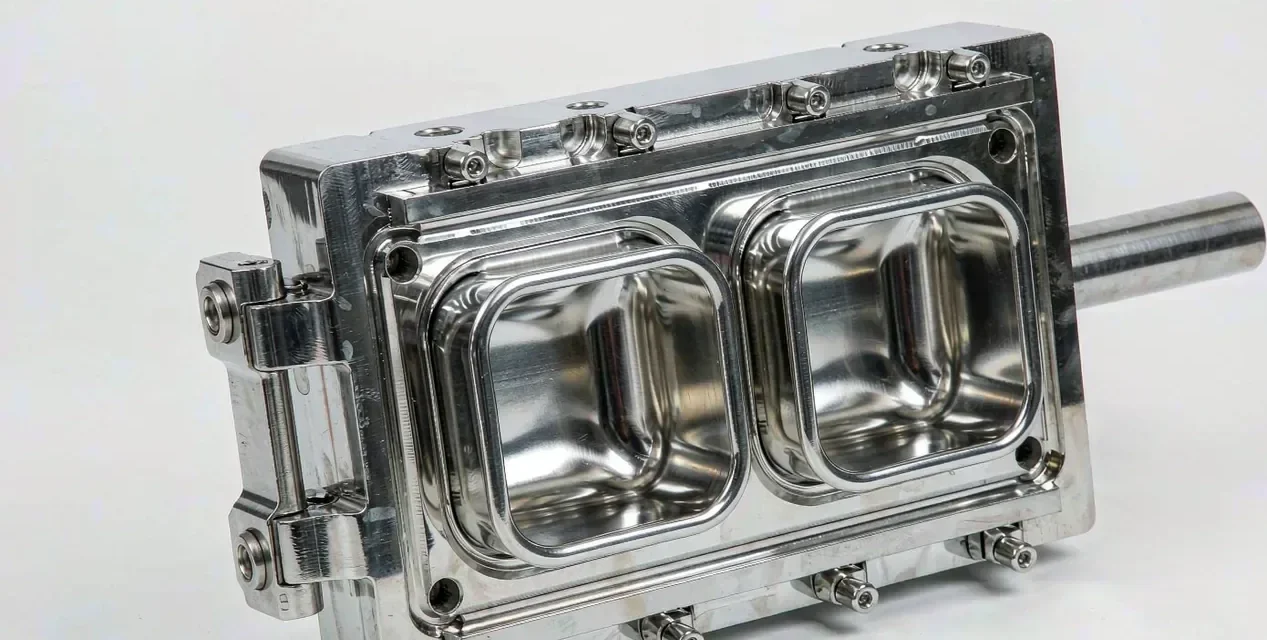
Food-grade injection molding is a chain of evidence, not a certificate. The resin must be an authorised food-contact grade, the processing must not add anything the resin did not already contain, and the finished part must be shown to transfer no more than the legal limit under your actual contact conditions. Most disputes about food-contact parts are not about the material at all; they are about missing documentation, a shared tool, or a test performed at the wrong condition. This guide sets out which regulation applies where, what a buyer should put in the purchase specification, and where compliance is usually lost between the material dock and the finished part.
Which regulation applies to which market
The first question is not technical, it is commercial: where is this part going to be sold, and what will it touch? A part can be entirely legal in one market and need additional documentation for another. There is no single “food grade” that covers the world, and there is no FDA approval number for a molded container that a supplier can put on a datasheet.
What the frameworks share is the principle that the material must not render the food injurious, and that responsibility sits with the party that places the article on the market. What they differ on is mechanism. The EU runs a positive list with migration limits set per substance, and requires a declaration of compliance for each material-and-part combination. The US framework lists permitted additives and their conditions of use under 21 CFR, and migration limits are derived from toxicological data rather than read directly off a list for every substance.
| Market | Regulation | What it governs | Typical evidence |
|---|---|---|---|
| United States | FDA 21 CFR 174 / 175 / 177 | Indirect additives (174), adhesives (175), plastics (177). Plastics are listed per resin plus specific additives. | Resin grade with a supplier compliance statement; the buyer’s own migration test report. |
| European Union | Regulation (EU) 10/2011 | Plastic materials and articles intended to come into contact with food. Union list of authorised substances and migration limits. | Declaration of compliance issued against the exact finished part, with a DoP number. |
| Germany | LFGB (Lebensmittel- und Bedarfsgegenstaettengesetz) | National framework; section 3 requires LFGB suitability for food contact materials. | LFGB compliance statement; for multi-layer, a 3-layer test. |
| United Kingdom | The Materials and Articles in Contact with Food (England) Regulations 2012 | Post-Brexit GB regime; currently aligned with EU 10/2011 but diverges over time. | Declaration of compliance referencing the GB legislation. |
| Canada | Food and Drugs Act / Safe Food for Canadians Regulations | Prohibition on sale of food-contact materials that may render the food injurious. | Supplier declaration plus the buyer’s migration testing. |
| Japan | Food Sanitation Act (positive list) | Positive list of additives permitted for use in food-contact resins; includes recycled material conditions. | Resin grade confirming compliance with the positive list. |
One practical note before you go further: if the same component is used across several markets, decide the strictest applicable regime at the start rather than the market that is easiest to satisfy. Changing the declared compliance route later means re-testing the finished part and re-issuing the documentation, which is more expensive than specifying it correctly on day one.
Resin choice: what actually sets the ceiling
No amount of process discipline will make a non-food-contact grade into a food-contact part. The resin grade determines which substances are present in the material at all, and therefore what the theoretical maximum transfer is. Everything downstream, from the additives in the masterbatch to the moulding temperature, works within the envelope the resin has already established.
The trade-off you are making is not simply “safe versus unsafe”. It is performance versus availability. A grade that is compliant but unavailable in your region, or compliant only in thin sections, is not a useful answer. This is why resin selection belongs in the DFM conversation rather than in a compliance conversation that happens after the tool is built.
| Resin | Typical food-contact use | Compliance notes | Process notes |
|---|---|---|---|
| PP (polypropylene) | Containers, trays, closures, cutlery | Widely authorised for food contact in all major markets; available in both homopolymer and copolymer grades. | Low shrinkage and good weld lines. Common choice for living lids on hinged containers. |
| HDPE (high-density PE) | Bottles, caps, crates | Standard food-contact grades available; good for closures where a tight seal is needed. | Good chemical resistance to acids and detergents. Watch for weld-line weakness in thin walls. |
| PET (polyethylene terephthalate) | Bottles, trays, films | Food-contact applications are well established, including recycled-content grades with their own conditions. | Higher crystallinity needs accurate cooling. IV (intrinsic viscosity) affects both clarity and shelf life. |
| PS (polystyrene) | Cutlery, trays, rigid containers | Food contact permitted; modified grades exist for clarity and impact strength. | Brittle and stress-whitens. Common in disposable applications where cost dominates. |
| PC (polycarbonate) | Baby bottles, medical trays, drinkware | Food-contact use depends on the grade and on bisphenol restrictions in the target market. | Excellent clarity and impact strength. Requires drying before molding to avoid hydrolysis. |
| TRITAN (copolyester) | Reusable bottles, drinkware, food storage | Commonly used for food-contact articles; grades are typically BPA-free. | High clarity with good chemical resistance. Must be dried thoroughly before molding. |
| POM (acetal) | Food-contact mechanical parts, dispensers | Not a packaging resin; used where a food-adjacent part needs mechanical strength. | Avoid prolonged contact with strong acids. Sensitive to moisture during molding. |
Thin-walled parts deserve a separate word because the material behaves differently there. A 0.5 mm wall has far less time to cool, so the resin reaches a higher temperature for longer, and the same cooling system that works on a 2 mm wall will not serve a container lid. The flow analysis for a thin part is also more sensitive to the gate position than the wall thickness, and a gate that is fine for a rigid tray can leave a weld line across the sealing face of a living lid. This is why food-contact thin-wall work belongs with a supplier whose tooling engineers run flow analysis before cutting steel, not after the first short shot.
What migration testing does and does not tell you

Migration testing answers a narrow question precisely: how much of a defined material transfers into a defined food or simulant, at a defined time and temperature. The precision is the point. A result is only valid for the condition it was run under. A test at 40 degrees Celsius for 10 minutes says nothing about 70 degrees Celsius for 30 minutes, and it says nothing about oily food, because a simulant is chosen to mimic a food type.
That is the most common source of confusion. A part passes a migration test, goes into a food service application that runs hotter and longer, and then fails at the customer. The material did not change; the condition did.
| Test | What it measures | Typical condition | Why a buyer asks for it |
|---|---|---|---|
| Overall migration | Total mass of substance transferred to the food simulant. | Simulant chosen for the food type; specific time and temperature. | Confirms the part does not transfer more than the material’s overall limit. |
| Specific migration | Transfer of one named substance (for example a specific additive). | For the substance in question, at the most severe realistic condition. | Required where a substance has its own specific limit under EU 10/2011. |
| Sensory evaluation | Whether the food’s taste or odour changes. | Contact with the actual food or a matched simulant. | A printed or unpainted part can still cause off-flavour if the resin carries residual odour. |
| Colour fastness / contamination | Whether colour or dirt transfers to the food. | Contact with a moist food simulant or a defined wiping test. | Relevant for printed trays and for parts in contact with wet food. |
| Migration from the process | Residual substances left by the process itself. | The part as produced, before any downstream washing. | Covers printing inks, adhesives and any processing aid residue. |
Two categories of evidence exist and they are not interchangeable. Resin-level data establishes suitability in principle and comes from the resin supplier. Finished-part testing establishes actual transfer for your part, in your geometry, with your printing and your contact conditions. Many buyers accept the first for simple, unprinted, low-risk applications and require the second wherever the part carries extra risk: printing, adhesives, multi-layer structures, fatty food, or anything used by children.
Note also that migration testing on the finished part catches what the resin data cannot: printing inks, adhesives, and residue introduced by the process. If your part has a printed decoration, a label applied in-line, or any secondary operation, the finished part and not the resin is the object that has to be tested.
What a compliant supplier should give you
You do not need a supplier who says the word “compliant”. You need one who can tell you, in writing, which resin grade went into which lot, and produce the documentation trail behind that claim. The following is what to ask for before the tool is cut, and what to check at every order.
- Resin grade and supplier, with a current declaration. Not a family name like “food grade PP” but a specific grade, from a named producer, with a declaration that carries a date.
- Material certificates per lot. A certificate that applies to “our PP” is worthless once the lot changes. Ask for the lot number and the grade together.
- A declaration of compliance for the finished part, where the regime requires it, issued against the actual part and referring to the actual substances used.
- Migration test data for the condition the part is used in, and a clear statement of the conditions it does not cover.
- A process statement covering material control, drying, purging and changeover.
- Change control. Written notice before any resin, masterbatch, colour or process change, with a stated period during which you can require samples.
Ask to see a sample of the documentation before you place the order, not after the first delivery. A supplier who cannot produce a document for a component they already quote is telling you something useful about the other component.
Writing the purchase specification
Most food-contact disputes trace back to an underspecified purchase order. The buyer assumed one contact condition, the supplier engineered for another, and both were working from their own reading of a two-line description. The fix is a specification that makes the compliance scope explicit.
| Item to specify | Why it matters | Example wording |
|---|---|---|
| Target market and regulation | The same part can be compliant in one market and not another. | “Parts for sale in the EU and Switzerland, compliant with Regulation (EU) 10/2011.” |
| Intended food type and contact conditions | Determines which simulant, time and temperature apply. | “Contact with fatty food at 70 degrees Celsius for 30 minutes during use.” |
| Resin grade and supplier | The grade determines the compliance route and the declaration you can rely on. | “PP, food-contact grade, with a current supplier declaration of compliance.” |
| Documentation required | Saves weeks of chasing individual certificates. | “Declaration of compliance, migration test report, and material certificates for every lot.” |
| Who performs the testing | Decides whether you rely on the resin supplier’s data or need your own testing on the finished part. | “Supplier to provide resin-level data; buyer to commission migration testing on the finished part.” |
| Change control | Any resin or process change can invalidate the compliance data. | “Supplier to notify the buyer of any resin, masterbatch or process change before implementation.” |
| Traceability requirement | Food recalls require the ability to trace a lot back. | “Lot code moulded into the part; resin lot recorded against each production lot.” |
Two clauses in that table are worth singling out because they are the ones most often left out and most often regretted. The first is who performs the testing. If the resin supplier’s data is accepted for a flat unprinted part but the finished part is tested for anything printed, multi-layer or used with fatty food, write that split down explicitly, because it determines both the cost and the timeline. The second is change control. A masterbatch change or a resin producer’s reformulation can invalidate completed migration data without anything about your part having visibly changed. If the supplier is not obliged to tell you, you find out from your own customer.
Where compliance is lost in the process
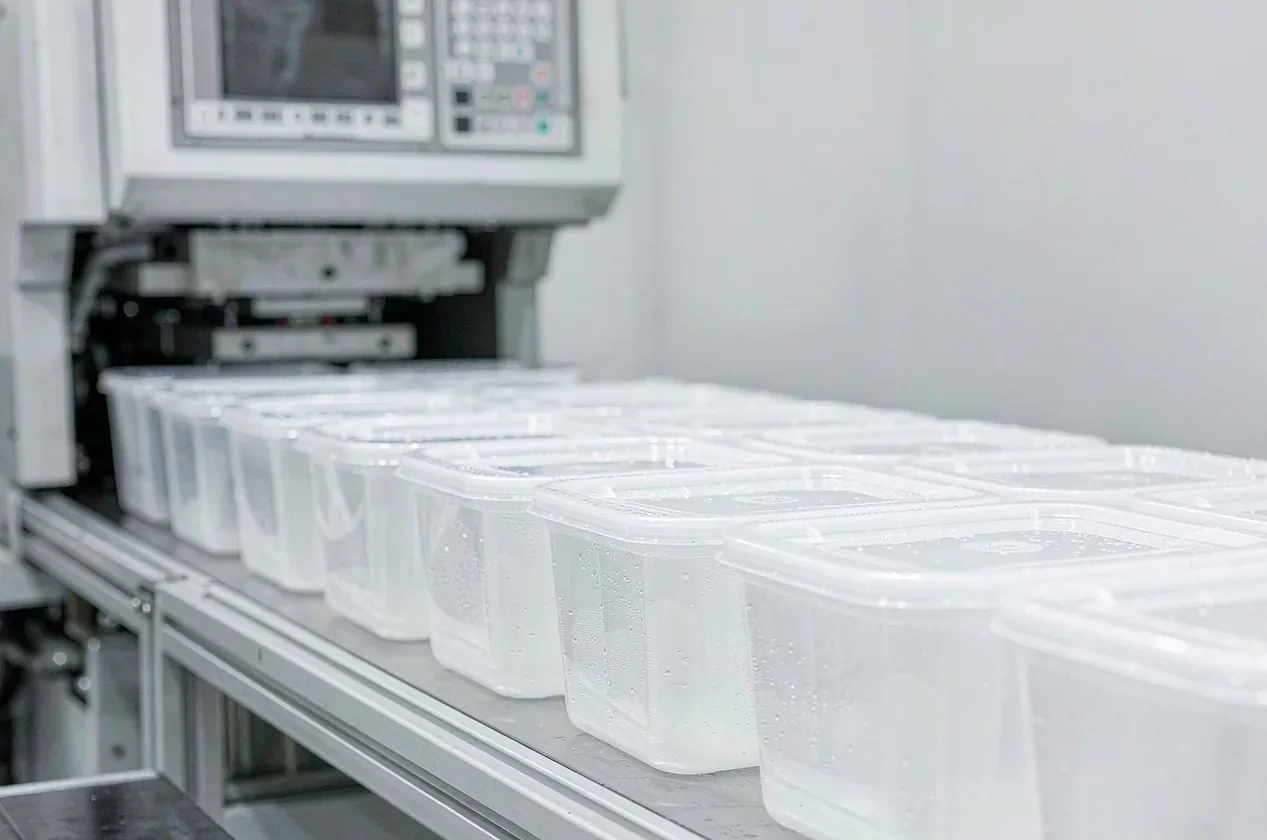
Material compliance is a purchase decision. Process compliance is where parts get rejected. The stages below are the ones that most often turn a correctly specified programme into a rejected lot.
| Stage | What can go wrong | Control |
|---|---|---|
| Material intake | Wrong grade delivered, or a grade without a current compliance statement. | Check the grade and the declaration at goods-in, before the material reaches the machine. |
| Drying | Residual moisture in hygroscopic grades such as PC, PET or TRITAN, causing hydrolysis and silver streaks. | Dry per the resin supplier’s specification and log the dew point and dwell time. |
| Machine setup | Residue or degradation product from a previous material remaining in the barrel. | Purge correctly when changing material. Schedule colour changes outside food-contact production. |
| Mold condition | Damaged cavity surface, flash or a worn ejector leaving marks on the sealing face. | Inspect the cavity against a defined sample before the run, not during it. |
| Cycle and cooling | Under-cured parts, or excessive cooling that embeds stress and causes distortion on the line. | Validate the cycle on the first article and re-validate after any change. |
| Handling and packing | Contamination introduced after molding, by operators or by packaging. | Define handling rules for the food-contact area and use food-grade packing. |
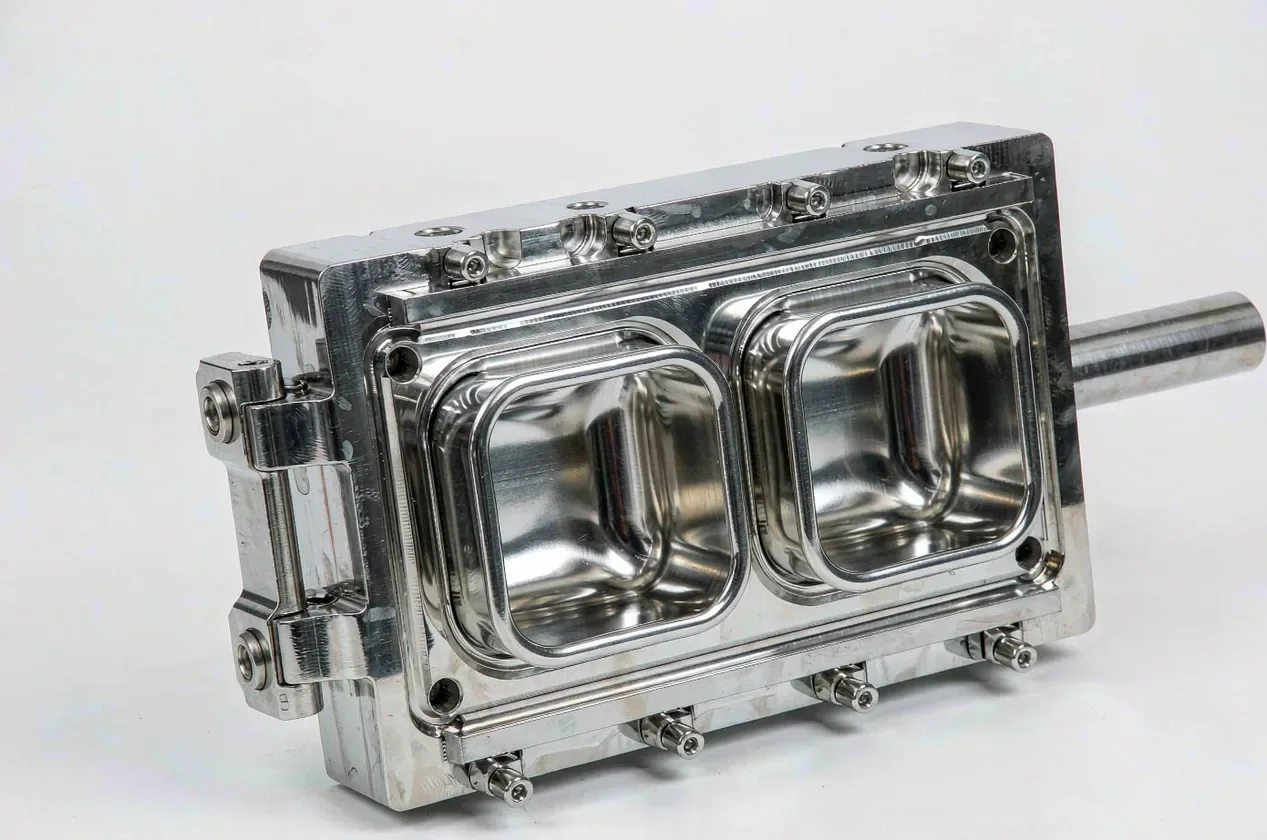
Machine condition deserves particular attention because it is invisible in the finished part until someone looks for it. A cavity with a scratch, a worn ejector pin leaving a witness mark, or a flash at the parting line can each affect a sealing face or a contact surface. The control that matters is a defined reference sample checked before the run rather than during it, because once a lot is on the line, the decision is no longer a technical one.
The same principle applies to the plant itself. In a regulated food supply chain, production of food-contact parts is normally segregated from non-food production, and colour changes are scheduled outside food-contact runs. This is not about suspicion; it is about being able to state, with evidence, what was in the machine before your lot ran.
Cost, lead time and how to keep both under control
The material premium for food-contact grades is usually small, and sometimes zero, because food-contact grades of PP, HDPE and PET are production grades rather than specialty products. The larger cost is administrative, and the larger delay is waiting for test results rather than waiting for parts.
Three decisions control most of the timeline. First, fix the compliance scope before the tool is cut, so that trial samples can be submitted for testing during the tool trial instead of after. Second, ask the resin supplier for their migration data on the same grade and condition you need, because much of the time it already exists and can shorten the path. Third, decide early whether your finished part needs its own testing or can rely on resin-level data plus a declaration, because that decision determines whether you are waiting weeks or days.
On cost, the item that surprises buyers is documentation. Producing a declaration of compliance that covers the right part, the right substances and the right conditions takes engineering time, and asking for it late means paying for it as an exception rather than as part of the process. This is another argument for settling the scope early.
It is also worth weighing whether the part needs to be moulded at all in every case. If a component is a pure structural or cosmetic element that does not touch food, the food-contact requirement may not apply to it, and saying so clearly in the specification saves both parties time.
The six claims that cause problems at audit
These are the statements that sound reassuring and are worth pushing back on. Each of them is common in supplier marketing and each of them leaves you without the evidence you need later.
“The plastic is FDA approved.” As described above, no such approval exists for a moulded part. Ask instead for the resin grade and the supplier’s regulatory declaration, and read what it actually says the material is authorised for.
“We work with food-grade materials.” Every injection molder has food-grade resin available, and most do run food-contact work sometimes. The question is whether this specific programme, this grade and this lot are covered by documentation you hold.
“It is dishwasher safe.” Dishwasher safe is a performance statement about heat and chemical exposure, not a compliance statement. A part can be dishwasher safe and not have any migration data behind it.
“We can provide any certificate you need.” This often means a certificate for the resin rather than for the part, or a document describing the resin family rather than the grade actually moulded.
“No migration is possible from a solid plastic part.” Migration is about molecules leaving the material, not about the part disintegrating. Additives, residual processing aids and printing inks all migrate, and solid parts are exactly where that matters most, because the contact surface is large and the material is in direct contact with food.
“We have ISO 9001 / IATF 16949, so quality is covered.” Quality management system certification is about process control. It says nothing about the specific compliance regime that applies to your part in your market, and it is not a substitute for either.
A working checklist for a food-contact part
Use this as the pre-production review for a new food-contact programme, or as a supplier qualification checklist. Every line should have an answer in writing before the tool is cut.
- Target market and the applicable regulation are named in the specification.
- Intended food type, contact time and contact temperature are stated.
- Resin grade is named, with producer and a current declaration.
- It is decided who performs migration testing, and at which conditions.
- The tool is dedicated to food-contact production, or the changeover procedure is defined and recorded.
- Drying parameters are specified for hygroscopic grades and logged per batch.
- Reference samples exist for cavity and parting-line inspection before each run.
- Lot codes are moulded into the part and resin lots are recorded per production lot.
- Change control notification is agreed in the contract, with a sample window before implementation.
- The declaration of compliance, where required, is issued against the finished part and not only against the resin.
If all ten lines are answered, the part is defensible. If one or two are open, they are usually the ones that create the problem later.
Frequently Asked Questions
What does food grade injection molding mean?
Is there an FDA approval for injection molded food containers?
What is the difference between FDA compliance and EU 10/2011?
Does LFGB apply if we only sell in the US?
Do I need migration testing if my resin is food grade?
What resin should I choose for food packaging?
How much does food-grade compliance add to cost and lead time?
Can the same tool make parts for both food and non-food use?
Where this applies
Send us the 3D file and the food-contact requirement
Share your STEP, IGS, X_T or PRT with the resin grade, the target market, the food type and the contact time and temperature. We will return a DFM review, a cavity and gate recommendation for the wall thickness, a steel selection with the reasoning, and an itemised quotation within 24 hours.
No obligation. NDA available.
- 23+ Years of experience
- 2,000+ Molds per year
- 24h Quote turnaround