
Project summary
Shiny Mold tooled and molded PC/ABS body shells and camera mounts for an industrial UAV program. Thin-wall sections down to 1.2 mm hold critical dimensions, and the two-cavity hot runner tool runs stable 24/7 automated production at our Chang’an, Dongguan factory.
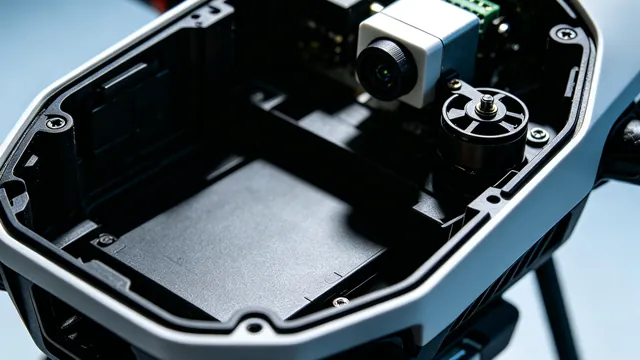
Project overview
Industrial drone programs live and die by weight and stiffness. Every gram in the body shell is a gram taken from payload or flight time, yet the shell still has to protect the flight controller, dissipate motor heat and survive hard landings. This project covered mold design, tooling and serial molding of a UAV body shell and camera mount in PC/ABS.
Shiny Mold ran the full chain in-house at our Dongguan factory: DFM review, mold-flow simulation, steel machining, trials and production molding. The customer approved the DFM in week one and received first shots from the production tool inside the standard 25–35 day custom mold window.
The challenge: thin walls without short shots
The shell combines a 1.2 mm thin-wall top panel with reinforced mounting bosses for arms and gimbal hardware. Flow length-to-thickness ratio is aggressive for PC/ABS, and cosmetic requirements rule out visible flow marks on the top surface.
- Hold wall thickness at 1.2 mm without short shots or burn marks.
- Keep boss concentricity inside tolerance so carbon-fiber arms assemble without reaming.
- Texture the top surface for glare control while keeping gloss uniform.
Mold design and build
Mold-flow simulation compared three gate layouts before steel was cut. The final two-cavity tool uses a hot runner with sequential valve gating so the thin panel fills from the center outward, keeping weld lines away from the arm mount bosses. Cavity and core inserts use pre-hardened 718H with polished texturing cores.
Venting followed the simulation air-trap map, which is what kept PC/ABS from scorching at the end of fill. Cooling was designed around the boss cluster, where heat gathers and would otherwise stretch the cycle.
Production and quality control
Serial production runs in an automated cell inside our 100+ press fleet (50T–1800T). Robots degate and place parts, and every cavity’s output is weighed as a drift check. Critical dimensions on the boss pattern are verified by CMM on a fixed sampling plan; surface gloss is checked against a signed master plaque.
First-article reports and material lot traceability ship with every batch, so the customer’s aerospace reviewer can audit the chain from resin to carton.
Results
The tool produced stable thin-wall filling with no short shots across pilot and serial runs. Boss concentricity held for tool-free arm assembly, and the textured top surface passed glare inspection. Cycle time settled where simulation predicted, keeping unit cost inside the program budget.
Related: our custom injection mold capabilities, precision mold making for tight-tolerance features, and injection molding cost breakdown if you are budgeting a UAV program. To quote a drone housing, send your 3D files — an engineer replies within 24 hours.
Production results
| Wall thickness | 1.2 mm held without short shots |
|---|---|
| Boss assembly | Tool-free arm mounting, no reaming |
| Cosmetics | Uniform gloss on textured surface |
| Cycle time | As predicted by simulation |
Project specification
| Part | UAV body shell + camera mount |
|---|---|
| Material | PC/ABS, textured class-A top surface |
| Mold type | 2-cavity, hot runner with valve gating |
| Steel | 718H pre-hardened inserts |
| Min wall | 1.2 mm thin-wall panel |
| Critical tolerance | u00b10.01 mm machining accuracy |
| Quality system | ISO 9001 (NQA), CMM sampling |
| Production | 24/7 automated cell, robot degating |
Frequently asked questions
Can you mold 1.2 mm thin-wall PC/ABS drone parts?
Yes. This UAV program runs 1.2 mm thin-wall panels in PC/ABS using hot runner valve gating and simulation-driven venting. The same approach applies to other thin-wall electronics housings.
Do you support rapid iteration for drone prototypes?
Yes. Rapid prototype and bridge tools can be delivered in 10u201315 days for design validation, then carried into a production tool once the design is frozen. See our rapid tooling guide for the trade-offs.
What documentation do you provide for UAV programs?
First-article inspection reports, CMM dimension layouts, material certificates and lot traceability ship with each batch u2014 sufficient for customer aerospace or agency audits.
Request a quote
Send us your CAD file, material and annual volume. You will receive a DFM review and an itemized quotation within 24 hours.
No obligation. NDA available.