
Project summary
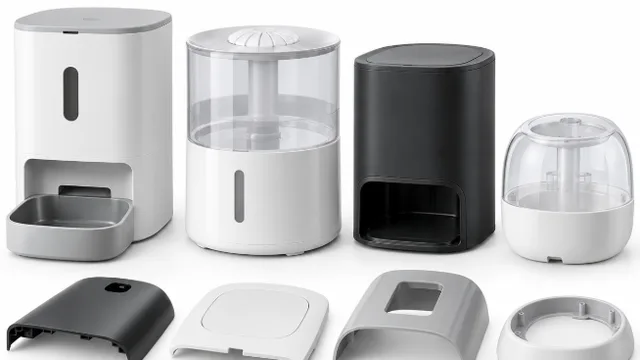
Shiny Mold tooled and molded the full housing set for a smart pet feeder and water fountain family: four SKUs in ABS and food-contact PP. Hidden gating keeps class-A curved surfaces free of marks, and assembly gaps stay consistent across the family — all built in-house at our Chang’an, Dongguan factory.
Project overview
Smart pet products live or die on the look of their housings. A feeder or water fountain sits on the living-room floor, so the shells need clean class-A surfaces, soft rounded corners and a fit that hides every parting line. This project covered mold design, tooling and serial molding of the housing set for a smart pet feeder and water fountain family: four SKUs sharing one visual language.
Shiny Mold ran the full chain in-house at our Chang’an, Dongguan factory — DFM review, mold-flow simulation, steel machining, trials and production molding. The housing set moved from DFM approval to first production shots inside the standard 25–35 day custom mold window.
The challenge: one look, four shells, no visible joints
The family mixes food-contact PP parts that touch water and kibble with ABS shells that carry the visible surfaces. Each housing curves around a transparent tank or an inlet opening, so weld lines and gate marks had to be kept off the front face entirely. Assembly gaps between the top shell, base and tray had to stay consistent across all four SKUs, because the parts share tooling logic and retail packaging.
- Class-A surfaces on curved housings, molded in both white and black.
- Food-contact-grade PP for the bowl, tank base and water path.
- Uniform assembly gaps across four SKUs built from shared tooling logic.
Tooling and molding decisions
Gates were placed behind hidden surfaces — inside the inlet openings and under the base rims — so fill marks never reach the front face. Mold-flow simulation set the cooling layout before steel was cut, which kept sink marks away from the large curved panels. Parting lines follow the rounded silhouettes instead of cutting across them, and all mating edges got their own dimensional checks so the four SKUs stay interchangeable on the assembly line.
Production runs in our 100+ machine fleet (50T–1800T) with documented process windows per shell. In-process checks cover assembly-critical gaps and the water-path dimensions; periodic full layouts keep every cavity inside the ±0.01 mm machining accuracy the tools were cut to.
Results
The housing set passed trial on the second shot after cooling adjustments held the curved panels sink-free. All four SKUs mold with consistent assembly gaps, and the food-contact PP parts show no gate haze on visible surfaces. The customer now molds the full family with us as a rolling program instead of sourcing shell by shell.
Planning a smart home or pet product? See more work in our project case studies, check the consumer electronics molding capabilities behind housings like these, and read the mold cost breakdown before you compare quotes. Ready to start? Send your 3D files — an engineer replies within 24 hours.
Production results
| Surface finish | Sink-free curved panels from trial 2 |
|---|---|
| Gates | Hidden inside inlets and base rims |
| Assembly gaps | Consistent across all 4 SKUs |
| Program status | Rolling family production, not per-shell sourcing |
Project specification
| Part | Feeder + water fountain housings, 4 SKUs |
|---|---|
| Material | ABS shells + food-contact PP water parts |
| Mold type | Multi-tool set, hot runner on main shells |
| Steel | 718H pre-hardened inserts |
| Cosmetic class | Class-A curved surfaces, white and black |
| Critical tolerance | ±0.01 mm machining accuracy |
| Quality system | ISO 9001 (NQA), CMM sampling |
| Tool lead time | Inside the 25–35 day custom mold window |
Frequently asked questions
Can you mold food-contact PP parts for pet products?
Yes. The water path parts in this project — bowl, tank base and fittings — are molded in food-contact-grade PP, with material traceability from resin lot to shipped carton and documentation available with each batch.
How do you keep gate marks off curved cosmetic housings?
By placing gates behind hidden surfaces such as inlet openings and base rims, then validating the layout with mold-flow simulation before steel is cut. On this housing set, fill marks never reach the front face and the curved panels molded sink-free from the second trial.
Can several SKUs share one tooling strategy?
They can, and it is usually cheaper. These four SKUs share one visual language and tooling logic, so mating edges got shared dimensional checks and the parts stay interchangeable on the customer’s assembly line without per-SKU rework.
Request a quote
Send us your CAD file, material and annual volume. You will receive a DFM review and an itemized quotation within 24 hours.
No obligation. NDA available.