
Project summary
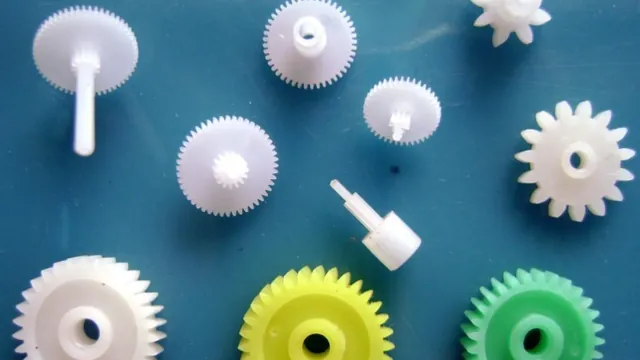
Shiny Mold tooled and molds a POM precision gear train for a consumer product, holding tooth profile and concentricity across a multi-cavity tool so the assembly meets its noise target without post-machining.
Project overview
Plastic gears do not forgive approximation. Tooth profile error becomes noise, concentricity error becomes binding, and moisture-driven swelling in the wrong resin becomes a gearbox that seizes in the field. This project covered molds for a POM gear train — drive, idler and worm gears — for a consumer product assembled at scale.
All tooling and molding runs at our Dongguan factory.
The challenge: noise and fit without machining
The customer wanted as-molded gears — no secondary machining, no hand fitting. That puts the whole tolerance stack on the tool:
- Tooth profile accuracy sufficient for the assembly’s acoustic target.
- Bore-to-tooth concentricity tight enough to avoid binding through the full gear train.
- POM’s swelling and shrinkage compensated in the steel, not discovered at assembly.
Mold design and build
POM shrinkage was mapped per geometry during DFM and compensated in the cavity steel, with the gear tooth profile cut on high-precision equipment and verified on a gear-measurement setup before tool assembly. Gates were placed and balanced so each gear fills symmetrically — asymmetric fill on a gear distorts the tooth circle and shows up directly as noise.
Ejector layout avoided pushing on the tooth rim, which would deform it before it cooled; parts are robotically removed and cooled in fixtures to hold roundness.
Production and quality control
In-process control includes per-cavity weighing and periodic tooth-profile checks against the master. Bore-to-tooth runout is measured on sampled parts from every cavity. The customer’s gearbox noise test is the final gate, and process changes that could move acoustics are treated as engineering changes, not operator tweaks.
Results
As-molded gears passed the customer’s acoustic and life testing without machining. Concentricity held across cavities, the gear train runs inside its noise budget, and the multi-cavity tools are carrying serial volume.
Related: precision mold making, the process guide, and defect diagnosis if you are chasing gear noise now. For a gear train quote, send your 2D drawing with tooth data.
Production results
| Acoustic test | Passed customer noise budget |
|---|---|
| Concentricity | Held across all cavities |
| Machining | Eliminated u2014 gears used as-molded |
| Status | Serial production, multi-cavity tools |
Project specification
| Part | Drive, idler and worm gears |
|---|---|
| Material | POM (acetal), low-noise grade |
| Mold type | Multi-cavity, symmetric gating |
| Tooth control | Profile cut and verified before assembly |
| Post-processing | None u2014 as-molded gears |
| Critical tolerance | u00b10.01 mm machining accuracy |
| Quality system | ISO 9001 (NQA) |
| Cooling | Fixture cooling to hold roundness |
Frequently asked questions
Can plastic gears be used as-molded without machining?
Yes u2014 when shrinkage is compensated in the steel, gating is symmetric, and parts are cooled in fixtures. This gear train runs as-molded and passes the customeru2019s acoustic and life tests.
Why POM for precision gears?
POM offers low friction, high stiffness, and stable dimensional behavior across humidity swings compared with nylon. The trade-offs are covered in our materials guide; for gears, POM is usually the default.
What data do you need to quote a gear mold?
The 2D drawing with tooth data (module, tooth count, profile tolerance), resin grade, annual volume and the mating gear specification. With those, we can commit to tooth-profile capability before steel is cut.
Request a quote
Send us your CAD file, material and annual volume. You will receive a DFM review and an itemized quotation within 24 hours.
No obligation. NDA available.